- OrthoThrive
- Posts
- Why You Don't Know the Real Hanukkah (And Why It Matters)
Why You Don't Know the Real Hanukkah (And Why It Matters)
How cultures survive when everything pressures them to disappear

Borris Upton
December 14, 2025
Hey there.
Most people think they know Hanukkah. They don't. And that's actually the point.
I didn't know much about it either until I started digging. What I found was stranger and more compelling than the simple story most people tell. It's not just about a holiday—it's about how a culture survives when everything around it pressures it to disappear.
Let me walk you through what I discovered.
The Maccabean Revolt was about reclaiming religious freedom
Around 164 BCE, something happened that most people have never heard of. A group of Jews called the Maccabees led a successful uprising against the Seleucid Empire. This wasn't just a battle over territory—the Seleucids had forbidden Jewish religious practices. They sought to enforce Hellenization, forcing Jews to abandon their traditions and adopt Greek culture instead.
The Maccabees fought back—and won. When they reclaimed Jerusalem, they rededicated the Temple. That's where the story gets truly interesting.
According to Jewish tradition, the temple lamp held enough oil to burn for one night—but it burned for eight. This is the miracle everyone knows about. But here's what struck me: the miracle wasn't just about oil. It was about spiritual persistence after cultural suppression. The Maccabees had achieved a military victory, but the oil burning for eight nights symbolized something deeper—that even in the darkest moment, when resources were scarce and hope faint, something sacred could endure.
That's why this story is so powerful. It's not just about winning a war. It's about winning the right to practice faith freely—and the belief that even when everything seems impossible, light can persist.
Hanukkah became major when American Jews needed cultural identity
Here's what surprised me most: for much of Jewish history, Hanukkah was considered relatively minor compared to Passover or Yom Kippur. It wasn't the major celebration we think of today.
But in the 1800s, something shifted. Jewish immigrants in America faced an overwhelmingly Christian environment where Christmas dominated the cultural landscape. Jewish families wanted their children to feel as celebrated as their Christian classmates during the winter holidays.
So Jewish congregations made a strategic choice. They began adapting certain Christmas customs—gift-giving, festive gatherings, special meals—to Hanukkah. What started as a way to preserve cultural identity in a Christian-majority country became a lasting tradition. Today, many American Jewish children receive small gifts each night of Hanukkah, often with a larger present on the final evening.
Communities across history reshape form while preserving meaning. That's how traditions survive.
The menorah lighting makes the ritual real
The menorah is the heart of Hanukkah. Each night, one additional candle is lit. Specific blessings are recited. The progression matters: you start with the shamash (the helper candle), then light one candle on the first night, two on the second, until all eight burn brightly by the final evening.
This gradual increase in light mirrors something deeper: light over darkness, knowledge over ignorance, freedom over oppression. The ritual is so central that it transcends geography. Whether you're in Mexico, Morocco, Tunisia, or New York, the menorah lighting connects Jews to the same historical moment and spiritual intention.
When a family gathers to light the menorah, they're participating in a 2,000-year-old tradition of remembering what it took to survive.
The foods of Hanukkah honor the miracle through oil
This is where I really started to appreciate the depth of the tradition. Latkes (fried potato pancakes) commemorate the oil that burned for eight nights. Sufganiyot (Hanukkah doughnuts) serve the same purpose. Everything circles back to that miracle of oil.
Simple Latke Recipe: Grate russet potatoes and squeeze out the water—this is key for crispiness. Mix the potatoes with grated onion, a couple of eggs, salt, pepper, and a few tablespoons of matzo meal (or flour) to bind it. Fry spoonfuls in hot oil until golden brown on both sides. Serve with sour cream or applesauce. The frying itself connects every bite back to the miracle.
Even the lesser-known tradition of eating cheese ties to a historical tale: Judith, a widow, used salty cheese to make an Assyrian general thirsty, gave him wine, and, once he was drunk, beheaded him—leading the Israelites to victory. It's a story of cunning, courage, and female agency in resistance.
These aren't random customs—they're symbols. Edible reminders of survival, victory, and the power of small miracles.
Hanukkah's meaning evolves with each generation's struggles
What struck me most is how this holiday transforms depending on who's celebrating and what they're facing. For Jews who lived through the Holocaust, Hanukkah took on new weight—it became a symbol of survival against impossible odds. For modern Jews, it represents resilience in the face of antisemitism and the importance of maintaining cultural identity.
The core message remains constant: a small group can overcome oppression and reclaim its freedom. But the meaning adapts to what each generation needs it to represent. That's how traditions stay alive—they aren't frozen in time, but living things that evolve while honoring their origin.
The bottom line
Hanukkah is far more than a holiday about oil or an ancient battle. It's a story about survival, cultural identity, and the power of small communities to resist assimilation. Every time a Jewish family lights the menorah, eats latkes, or gathers for Hanukkah, they're participating in a tradition that has evolved across centuries—yet always carries the same core message:
We survived. We're still here. And we're passing this story on to the next generation.
So let's light a candle—the first candle today.
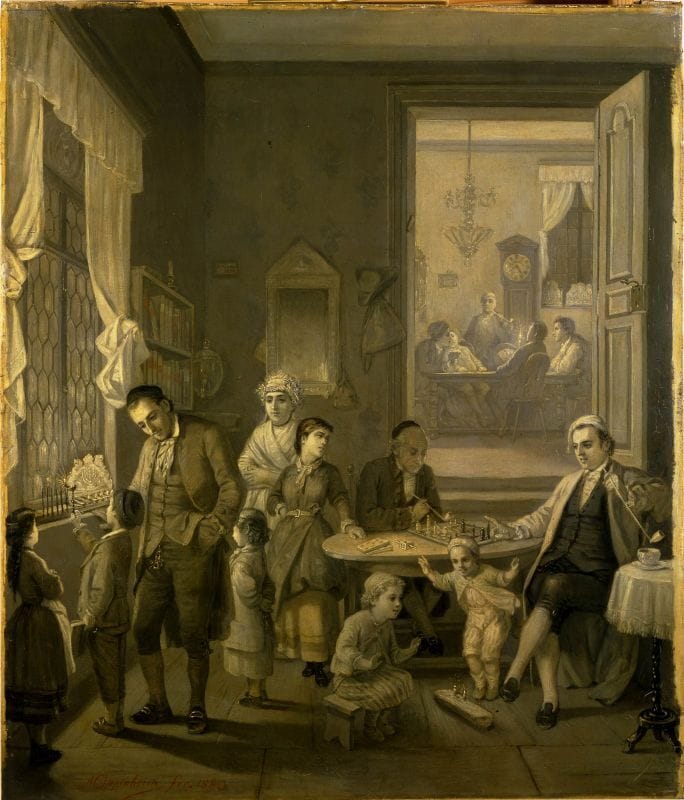
Image courtesy: Photo © The Israel Museum, Jerusalem (used with permission) imj.org.il/en/collections/350519-0
The Kindling of the Hanukkah Lights, 1881 Moritz Daniel Oppenheim (German, 1800–1882) Oil on canvas, 70.4 × 57.2 cm
Gift of Sally H. Cramer, London, in memory of his brother Herbert Collection of The Jewish Museum, New York Accession number: B51.01.0104