- OrthoThrive
- Posts
- History of Amercian Orthodontics 2
History of Amercian Orthodontics 2
How Four Breakthrough Appliances and a Refined Classification System Shaped Modern Orthodontics

Borris Upton
August 09, 2025
A Profession Takes Shape
By 1900, orthodontics in America had moved beyond its experimental beginnings. The specialty needed structure, common standards, and tools for precise, predictable results. Edward H. Angle stepped into that moment and left a legacy that still defines the field.
In 1899, Angle published his classification of malocclusion — Class I, Class II, and Class III — giving orthodontists a shared language for diagnosis. This system remains in use today. But Angle did not invent the idea of classifying malocclusion from scratch.
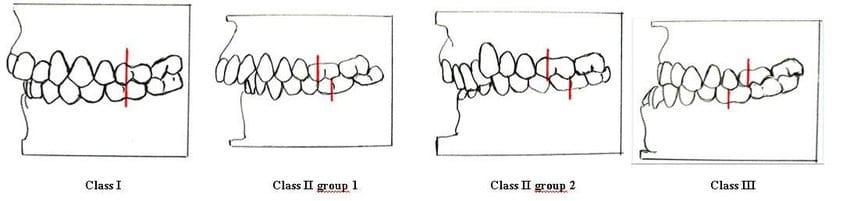
Angel’s classification. In: Klasyfikacja Angle'a
From Delabarre to Angle — Building on Earlier Foundations
Eighty years before Angle, Christophe-François Delabarre, a Parisian dentist, had already addressed the problem of categorizing irregularities. In his 1819 Traité de la seconde dentition, Delabarre described different types of malocclusion, linking them to developmental changes during mixed dentition. He identified crowding, spacing, protrusion, and crossbites, and tied these conditions to both functional and aesthetic consequences. An example of it was shown in Part 1 of the series.
Delabarre’s classification was pioneering, but it lacked the simplicity that would later make Angle’s system universal. His terminology was embedded in early 19th-century French dental language, which limited its adoption abroad.
Where Angle’s 1899 system differed — and why it became dominant — was in its clarity, reproducibility, and focus on molar relationships. Angle distilled malocclusion into three clear categories that could be quickly identified and communicated across practitioners and continents. In effect, he developed and streamlined Delabarre’s earlier work, transforming a detailed but cumbersome classification into a concise diagnostic tool. This refinement was one reason his system spread internationally and became a standard in teaching, research, and clinical records.
The E-Arch (1900): Controlling the Entire Arch
Angle’s innovations were not limited to definitions. In 1900, he introduced the E-Arch, his first major appliance. It used a rigid archwire running along the outer surface of the teeth, anchored to molar bands. By activating screws or springs, the orthodontist could expand the entire dental arch at once.
Earlier appliances often produced uneven or unpredictable movements. The E-Arch applied steady, distributed force, guiding teeth as a coordinated unit. Though large and cumbersome by modern standards, it proved that orthodontic movement could be systematically planned and achieved.
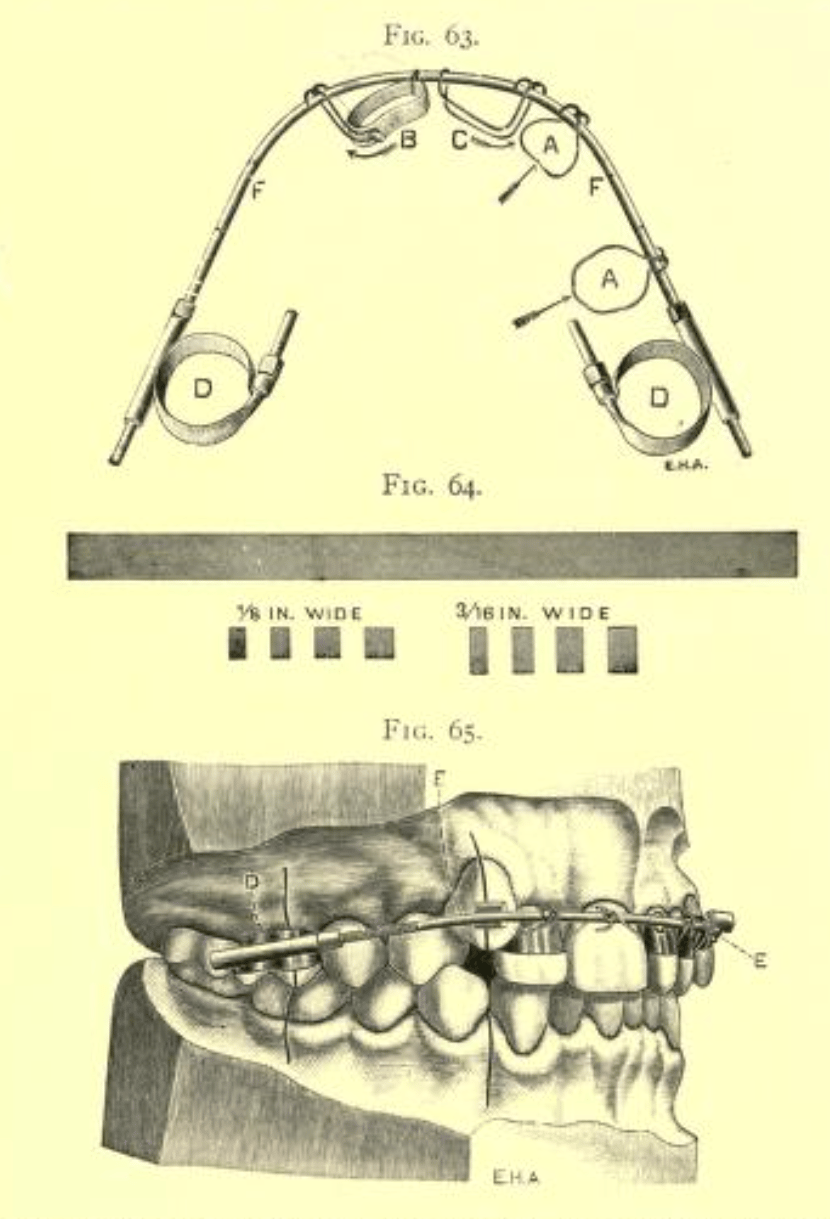
Angle EH. Treatment of malocclusion of the teeth and fractures of the maxillae. p. 90
Pin and Tube (1910): Targeting Individual Teeth
The Pin and Tube Appliance addressed one of the E-Arch’s key limitations: the lack of independent tooth control. Small tubes were soldered to the bands, and removable pins connected these tubes to a lighter archwire.
This setup allowed orthodontists to move individual teeth in specific directions while leaving others undisturbed. It brought a new level of precision to treatment, though it demanded meticulous skill and time to adjust. The appliance was an early demonstration that orthodontics could be both mechanical engineering and fine artistry.
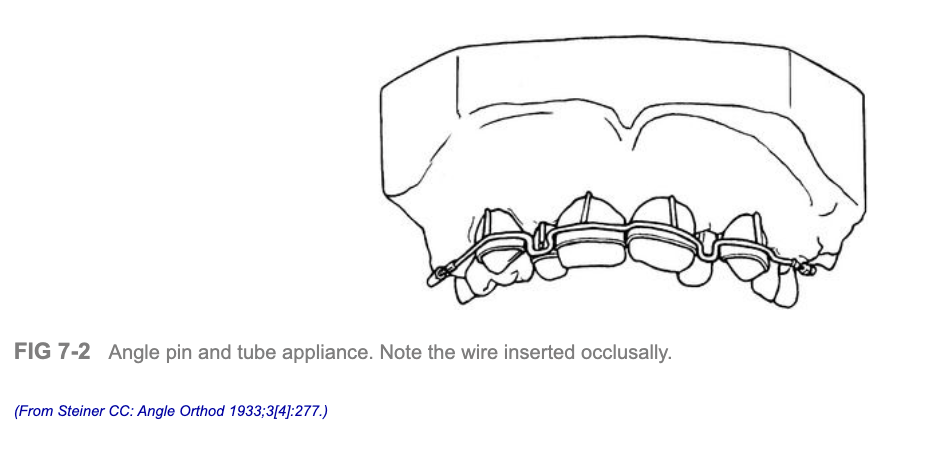
Pocket Dentistry. Fastest Clinical Dentistry Insight Engine. Chapter 7.
Ribbon Arch (1915): Aligning Crowns and Roots
With the Ribbon Arch, Angle tackled the challenge of root positioning. The appliance used a flat, ribbon-shaped archwire inserted into vertical bracket slots, allowing greater control over torque and angulation.
By aligning roots as well as crowns, orthodontists improved stability and the patient’s facial profile. The Ribbon Arch was an early recognition that lasting orthodontic success depends on correct root placement within the bone, not just on aligning the visible tooth surfaces.
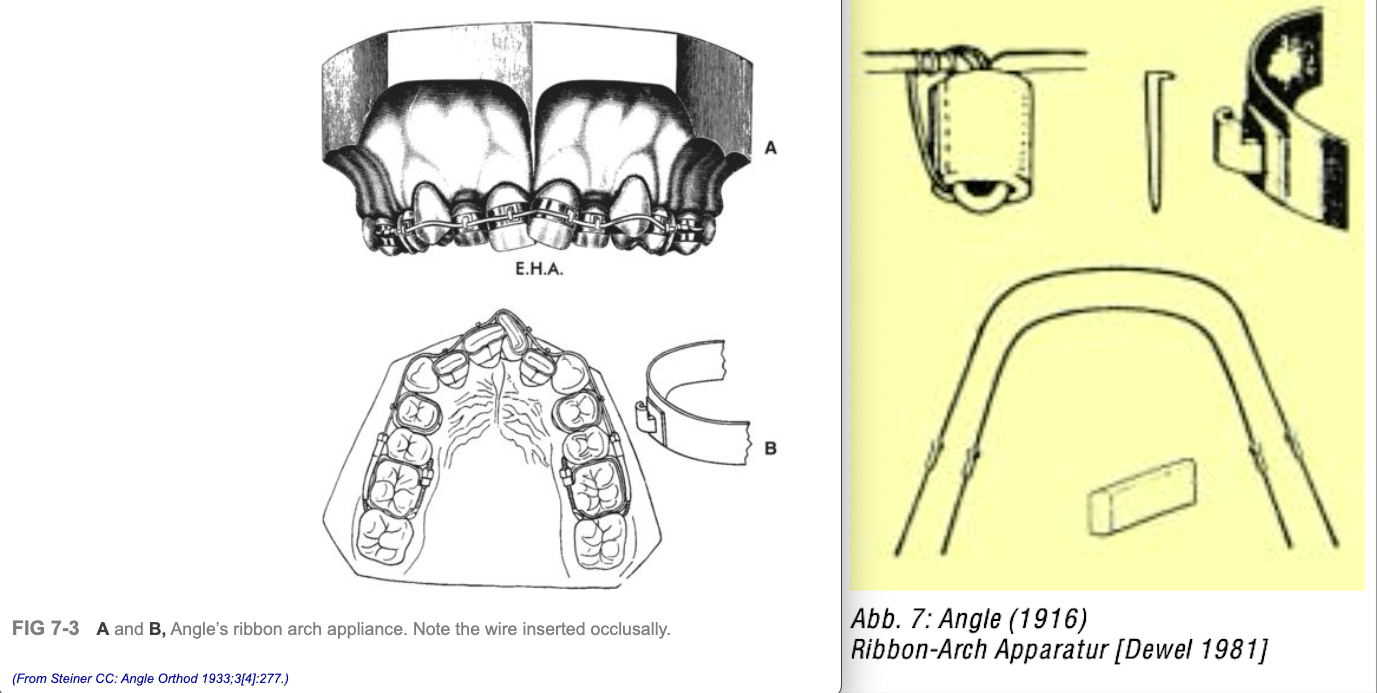
Pocket Dentistry. & Sonnenberg Kieferorthopädie
Edgewise Appliance (1925): Setting the Modern Standard
The Edgewise Appliance, introduced in 1925, was Angle’s most influential mechanical innovation. By rotating the bracket slot 90 degrees from the Ribbon Arch design, it gave orthodontists full control over tip, torque, and in–out movement.
This became the blueprint for modern bracket systems. Materials, bonding methods, and wire alloys have evolved, but the fundamental Edgewise principle still anchors fixed appliance therapy today.
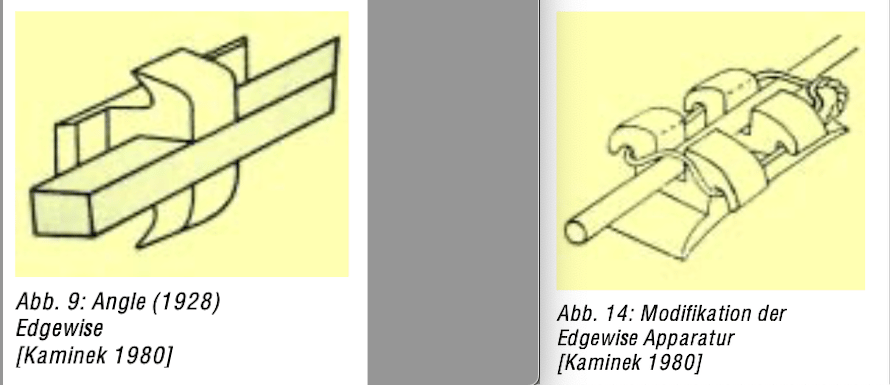
Sonnenberg Kieferorthopädie, Die Entwicklung der festsitzenden Apparatur.
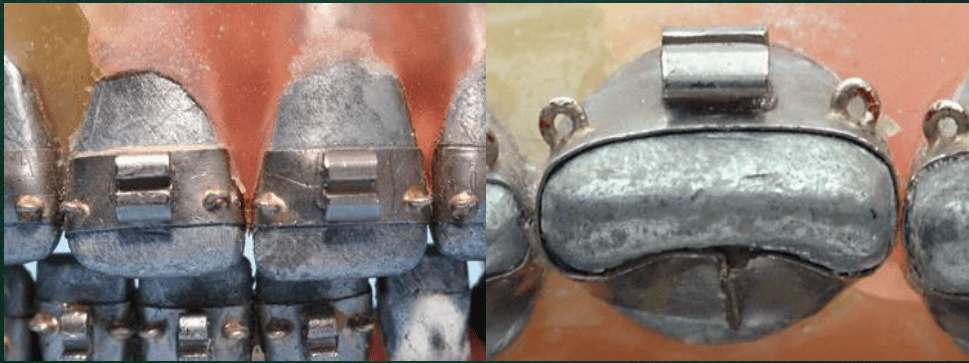
Ass. prof. Munad Jihad AL Duliamy. Fixed Orthodontic appliances.
Voices Beyond Angle
The era also belonged to other innovators. Calvin S. Case in Chicago argued for extractions when they improved facial harmony and treatment stability, challenging Angle’s non-extraction philosophy. Their public debates forced the profession to weigh aesthetics alongside occlusion in treatment planning.
Across Europe, Alfred Gysi in Switzerland refined archwire adaptability, Georg B. Schur in Austria explored lingual appliance concepts decades ahead of their time, and Viggo Andresen in Denmark developed functional appliances that worked with natural jaw growth — a concept later embraced in American pediatric orthodontics.
Closing Thought
Between 1900 and 1930, orthodontics matured into a science with a shared language, a precise diagnostic framework, and appliances capable of controlled, predictable results. Angle’s enduring achievement was not only his mechanical ingenuity but also his refinement of Delabarre’s early classification into a concise system that became the profession’s common tongue. This fusion of inherited knowledge and original invention is what truly defined the Golden Age of Innovation.
📚 Sources & References
Primary Historical Sources
Delabarre, C.-F. (1819). Traité de la seconde dentition. Paris.
Angle, E.H. (1907). Treatment of Malocclusion of the Teeth. Philadelphia: S.S. White Dental Manufacturing Co.
Case, C.S. (1908). A Practical Treatise on the Technics and Principles of Dental Orthopedia. Chicago: C.S. Case Company.
Pfaff, Wilhelm (1906). Lehrbuch der Orthodontie für Studierende und Zahnärzte mit Einschluß der Geschichte der Orthodontie. Dresden: Verlag der Zentralstelle für Zahnhygiene.
https://archive.org/details/lehrbuchderortho00pfaf/page/419/mode/1up
Angle EH. Treatment of malocclusion of the teeth and fractures of the maxillae. In: Angle's System. 6th ed. Philadelphia, Pa.: SS White Dental Mfg Co;1900 (public domain). https://archive.org/details/treatmentofmaloc00angliala/page/n5/mode/2up
Secondary & Contemporary References
Wahl, N. (2005). "Orthodontics in 3 millennia. Chapter 2: The opening of the era of modern orthodontics." American Journal of Orthodontics and Dentofacial Orthopedics, 127(2), 261–266.
Proffit, W.R., Fields, H.W., & Sarver, D.M. (2018). Contemporary Orthodontics. St. Louis: Elsevier.
Graber, L.W., Vanarsdall, R.L., Vig, K.W.L., & Huang, G.J. (2016). Orthodontics: Current Principles and Techniques. St. Louis: Elsevier.
Sonnenberg Kieferorthopädie, Die Entwicklung der festsitzenden Apparatur. https://www.kfo-stuttgart.com/dr_sonnenberg.html?file=files/sonnenberg_kieferorthopaedie/Download/Publikationen/ZM_Geschichte_Feste_Gesamt.pdf
Pocket Dentistry. Fastest Clinical Dentistry Insight Engine. Chapter 7. Orthodontic Appliances. https://pocketdentistry.com/7-orthodontic-appliances/
Ass. prof. Munad Jihad AL Duliamy. Fixed Orthodontic appliances. https://uomustansiriyah.edu.iq/media/lectures/3/3_2023_04_16!09_48_49_PM.pdf
Angle’s classification. In: Klasyfikacja Angle'a. https://pl.wikipedia.org/wiki/Klasyfikacja_Angle'a