- OrthoThrive
- Posts
- History of Amercian Orthodontics 8
History of Amercian Orthodontics 8
The Future of Orthodontics - From Smart Software to Lab-Grown Teeth — Charting what to come

Borris Upton
August 12, 2025
Standing on the Shoulders of Giants
Every bracket, aligner, and expansion screw in use today carries the legacy of more than two centuries of innovation. From Delabarre’s early classification of malocclusion to Angle’s precision appliances, from Schwarz’s expansion plates to AI-driven aligner staging, orthodontics has evolved through a continuous, global exchange of ideas.
The next century will not erase this history — it will build upon it. Advances in computing, biology, and global connectivity are set to change not only how we move teeth, but how we define orthodontic care itself.
AI and Predictive Treatment
Artificial intelligence is shifting from an experimental add-on to an everyday clinical partner.
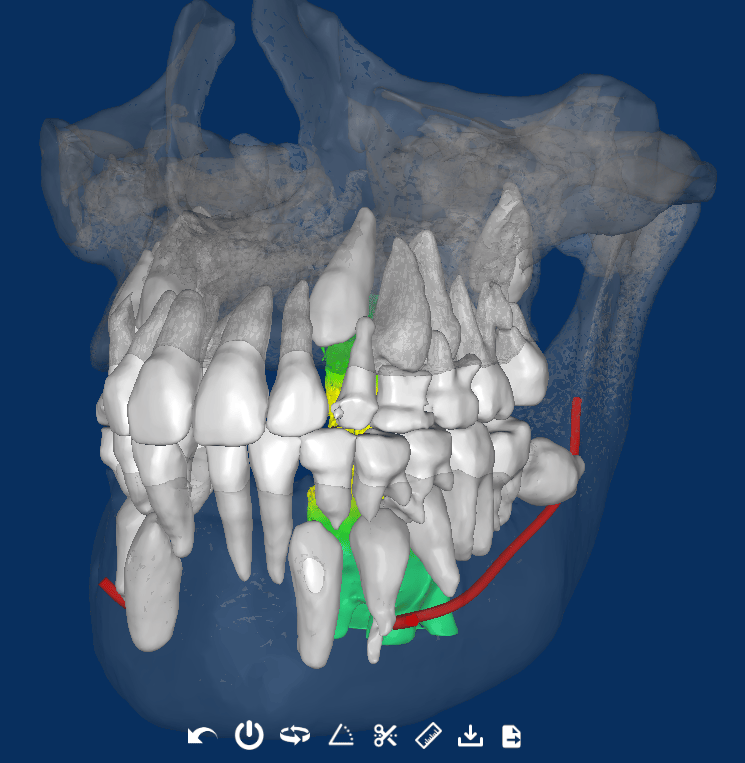
Diagnostics: AI systems are now capable of reading radiographs, CBCT scans, and even patient selfies with accuracy approaching that of experienced clinicians.
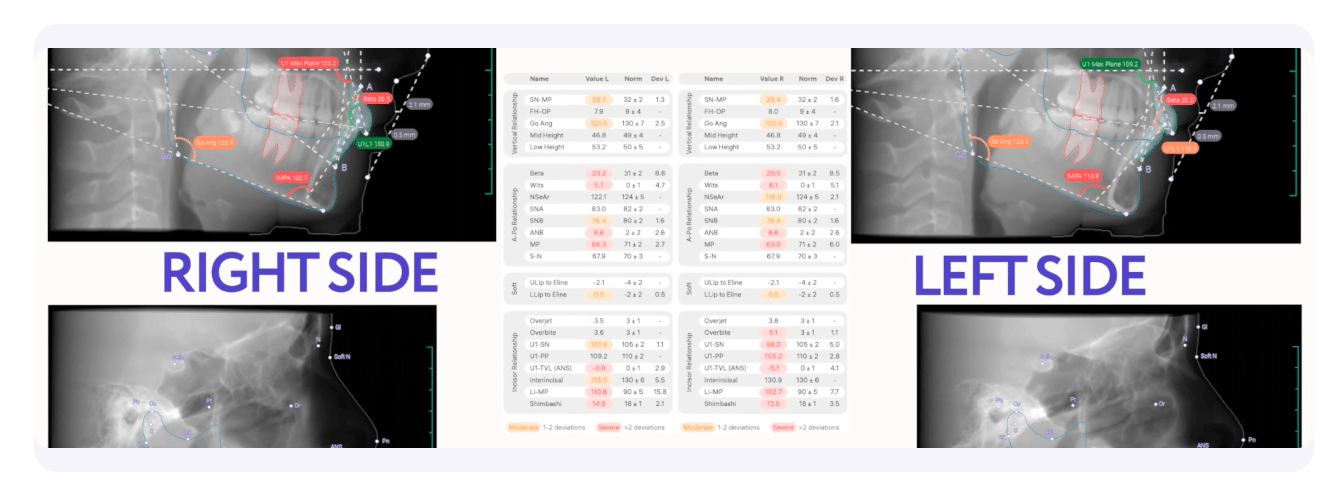
AI powered diagnostics. In: diagnocat
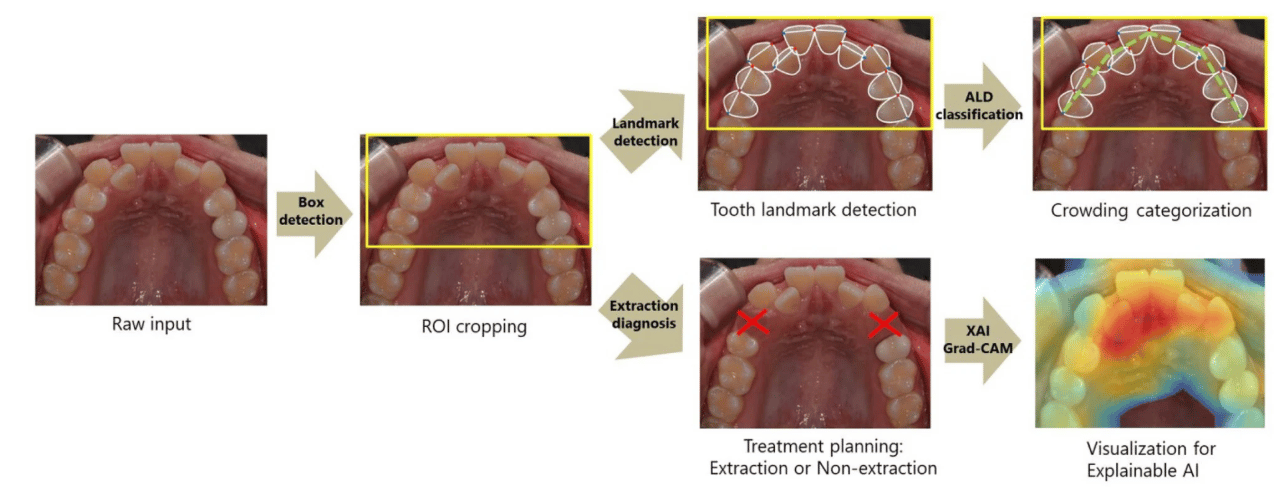
Overall flow diagram of the processes: the input photographs initially undergo ROI cropping and are then fed into the models for landmark detection, crowding categorization, and tooth extraction diagnosis.
In: Evaluation of artificial intelligence model for crowding categorization and extraction diagnosis using intraoral photographs.
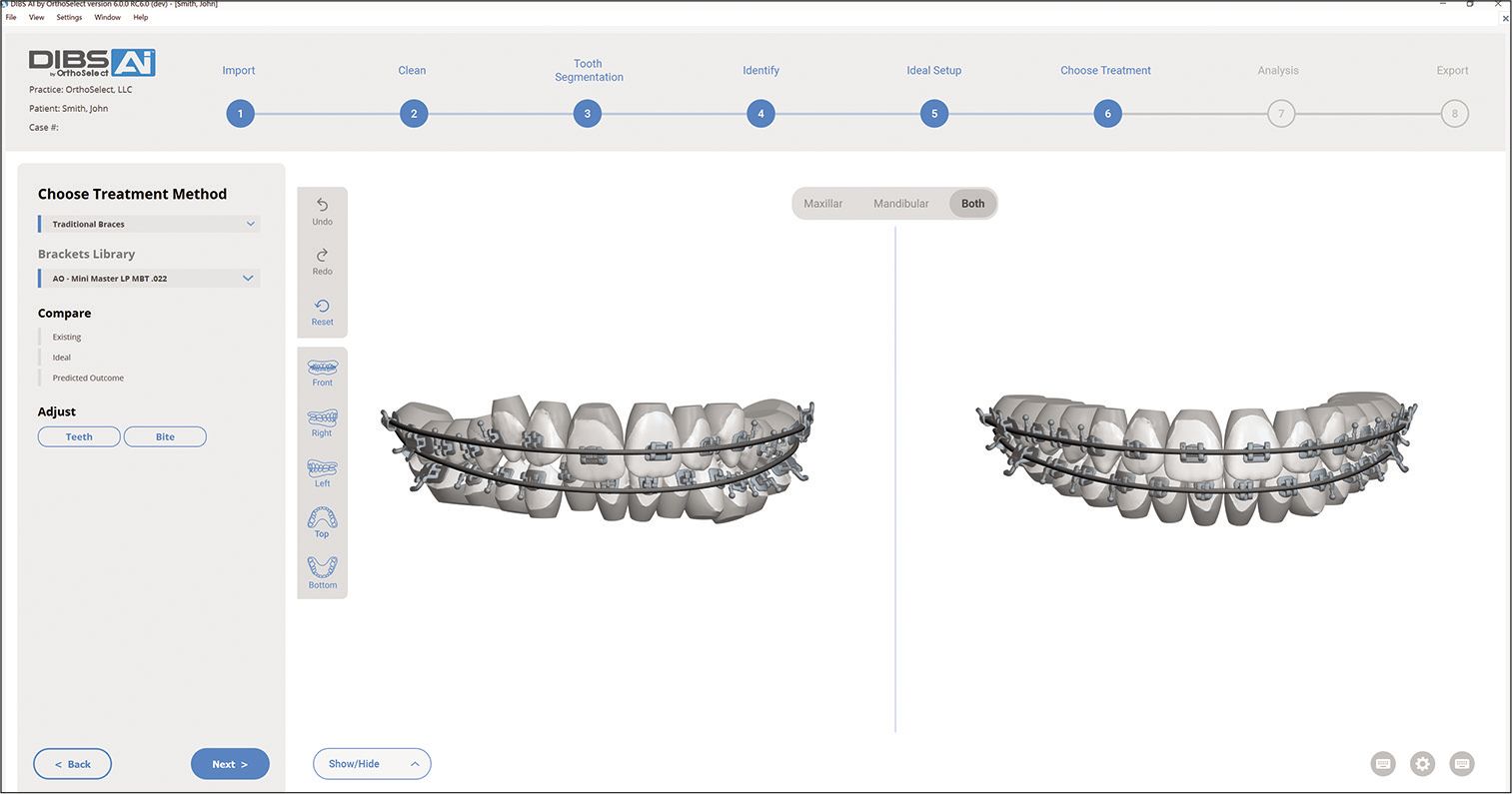
Indirect bracketing using artificial intelligence. In: The role of AI and machine learning in contemporary orthodontics
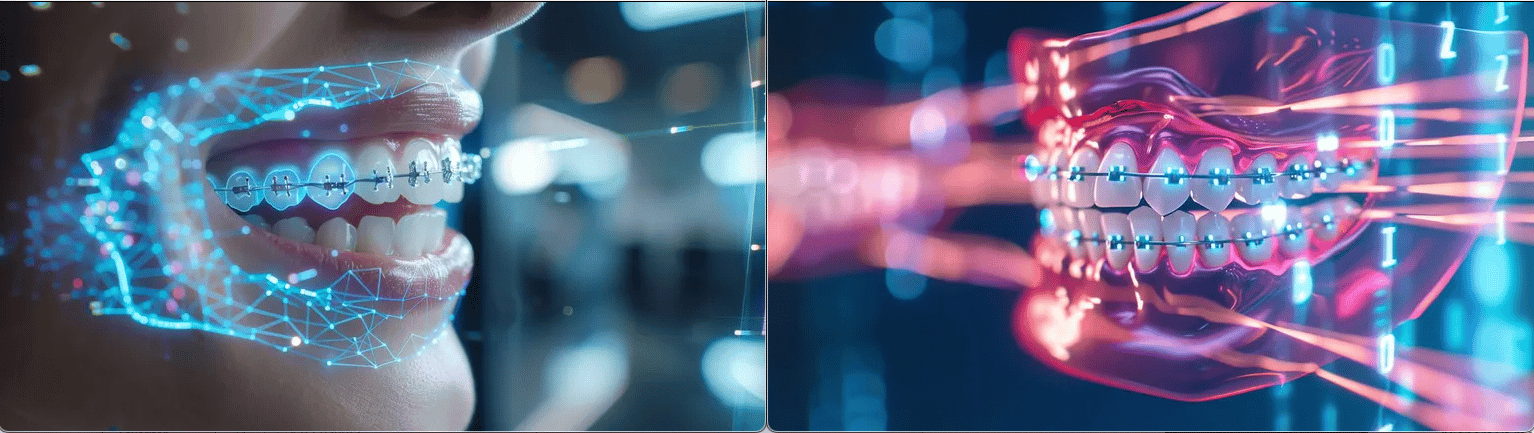
In: Predictive analytics for smarter treatment decisions & AI in treatment planning and 3D simulation
Treatment Simulation: Algorithms can design step-by-step movement plans for aligners or fixed appliances, with each tooth movement modeled in 3D.
Outcome Prediction: Some platforms are beginning to forecast not just the immediate post-treatment result, but long-term stability — before the first bracket is bonded or the first aligner is printed.
Example: A patient’s digital twin can be “aged” five or ten years in software, showing how their bite and profile might change over time.
Artificial intelligence (AI) in orthodontics has moved beyond experimental applications to become a core component of clinical workflows, influencing diagnosis, treatment planning, simulation, outcome prediction, and patient engagement. With rapid advances in machine learning, deep learning, and multimodal data integration, AI is transforming how orthodontic care is delivered and managed.
Limitations and Future Research Needs
Key challenges include ensuring data privacy, interpretability of AI models, standardized clinical validation, and integration with clinician expertise rather than replacement.
The future will likely see deeper integration of AI with biomechanics, genetics, and smart orthodontic devices for even more personalized and efficient treatment.
Teleorthodontics and Remote Monitoring
The pandemic years accelerated a trend already in motion — the decoupling of treatment progress checks from in-person visits.
Remote Monitoring Tools: Systems like DentalMonitoring use smartphone cameras to track tooth movement between appointments.
Expanded Access: Rural patients or those in underserved regions can connect with specialists without geographic barriers.
Balancing Act: While remote tools increase convenience, they also challenge the traditional oversight model. Future protocols will need to ensure that clinical safety is never sacrificed for speed or convenience.
Bioengineering and Skeletal Modulation
The biology of orthodontics is entering a new experimental phase.
Lab-Grown Teeth: Research teams in Japan, the UK, and the U.S. are exploring bioengineered tooth buds that could replace lost dentition entirely.
Bone Remodeling Control: Advances in biochemical signaling could one day make it possible to accelerate or slow skeletal growth on demand.
Orthopedic Applications: Non-surgical skeletal modulation — guiding jaw growth in adolescents through targeted molecular therapy — could reduce reliance on orthognathic surgery in severe cases.
Ethics and Global Access
Technology is advancing at a speed that raises important ethical questions:
Digital Divide: If AI-driven orthodontics becomes standard, will patients in lower-income regions have equal access?
Global Standards: International guidelines will be needed to ensure that emerging tools meet safety and quality benchmarks across different healthcare systems.
Data Privacy: With cloud-based scans and AI training datasets, safeguarding patient information will be as important as clinical results.
Closing Thought
The innovations ahead will come faster than those behind us — and they will be shaped by the same collaborative, transatlantic spirit that defined orthodontics in the last century. The difference is that now, a new idea can cross the ocean in seconds, not months. The next generation of orthodontists will inherit not just the tools, but the responsibility to use them wisely, equitably, and with the patient at the center.
📚 Sources & References
Contemporary & Emerging Research
Proffit, W.R., Fields, H.W., Larson, B.E., & Sarver, D.M. (2023). Contemporary Orthodontics, 7th ed. Elsevier.
Graber, L.W., Vanarsdall, R.L., Vig, K.W.L., & Huang, G.J. (2016). Orthodontics: Current Principles and Techniques. Elsevier.
DentalMonitoring. (2024). Remote patient monitoring solutions.
Sharpe, P.T. (2020). “Regenerative dentistry: lab-grown teeth and beyond.” Nature Reviews Dentistry, 1(1), 1–2.
AI in Dentistry Working Group. (2023). “Guidelines for safe integration of AI in dental practice.” Journal of Dental Research.
AI powered diagnostics. In: diagnocat. https://diagnocat.com/de/solutions/dentists/orthodontists
Preview the case in 3D View: https://cephx.com/cephx-ai-simplifying-complex-orthodontic-cases/
The role of AI and machine learning in contemporary orthodontics:
https://apospublications.com/the-role-of-ai-and-machine-learning-in-contemporary-orthodontics/Predictive analytics for smarter treatment decisions & AI in treatment planning and 3D simulation. https://imageorthodontics.com/orthodontic-innovation-artificial/
Evaluation of artificial intelligence model for crowding categorization and extraction diagnosis using intraoral photographs. https://www.nature.com/articles/s41598-023-32514-7
AI-driven dynamic orthodontic treatment management: personalized progress tracking and adjustments—a narrative review. Xuanchi Guo, Yuhan Shao. https://www.frontiersin.org/journals/dental-medicine/articles/10.3389/fdmed.2025.1612441/full
Rellyca Sola Gracea, Nicolas Winderickx, Michiel Vanheers, Julie Hendrickx, Flavia Preda, Sohaib Shujaat, Maria Cadenas de Llano-Pérula, Reinhilde Jacobs, Artificial intelligence for orthodontic diagnosis and treatment planning: A scoping review, Journal of Dentistry, Volume 152, 2025, 105442. https://doi.org/10.1016/j.jdent.2024.105442. (https://www.sciencedirect.com/science/article/pii/S0300571224006122)